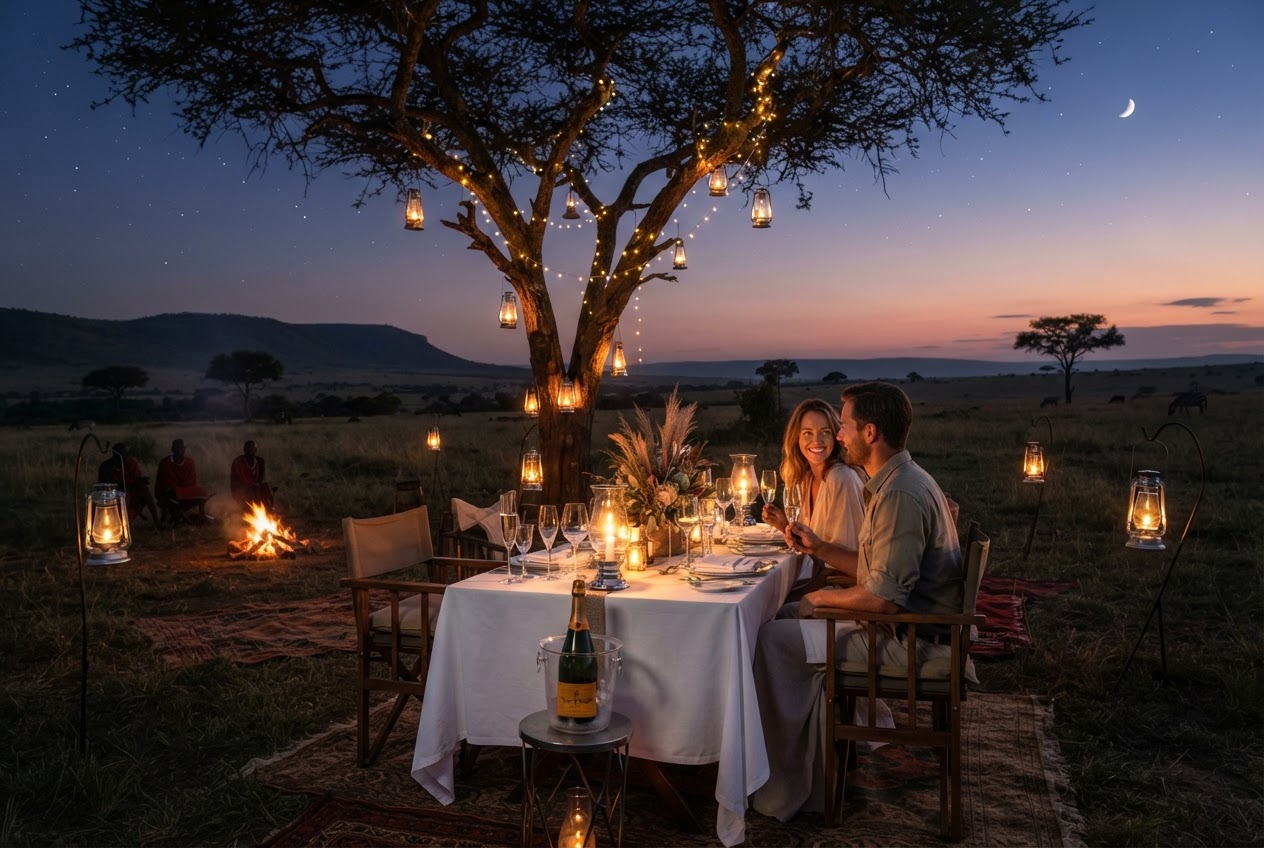
Illustrative safari dining scene.
An African honeymoon safari is one of the few trips that delivers on every romantic cliché and then quietly exceeds it — sundowners on an endless savannah, a private deck above a river where elephants drink at dawn, and nights under a sky so thick with stars it barely looks real. But a safari is also a trip with a lot of moving parts: timing, regions, lodges, flights, budget and the logistics of pairing the bush with a beach. Get those decisions right and you come home with the honeymoon of a lifetime. Get them wrong and you spend your first week of married life bouncing between the wrong camps in the wrong season.
This guide walks you through everything to consider when planning an African honeymoon safari, in the order you should think about it — so you can design a trip that fits your style, your calendar and your budget.
Why choose a safari for your honeymoon?
Most honeymoons are about rest. A safari is about wonder — and, done well, both. The appeal for newlyweds is simple: it is shared, screen-free time in an extraordinary setting, with none of the day-to-day decisions to make. At a good safari camp your meals, drives, drinks and even your laundry are handled; your only job is to be present with each other and with the wildlife.
A honeymoon safari also scales beautifully. You can keep it intimate and wild — just the two of you in a tented camp — or build a two- or three-week journey that strings together big-cat country, a gorilla trek and a barefoot beach. That flexibility makes a safari an appealing choice for couples who want to combine adventure with time to unwind.
1. When to go: timing is everything
The single biggest factor in a successful honeymoon safari is when you travel. Africa doesn't have one "best" season — it has the best season for what you want to see.
Dry season (roughly June–October) is prime game-viewing time across East Africa. Vegetation thins out, animals cluster around water, and the days are reliably sunny. In Kenya's Maasai Mara, July to October is a common window for Great Migration river-crossing sightings, although timing varies with rainfall and wildlife movements; crossings cannot be guaranteed — arguably the greatest wildlife spectacle on earth.
Green/short-rains season (November–December) brings lush landscapes, newborn animals, excellent birding and far fewer vehicles. Rates are often lower and camps quieter — ideal if you want privacy over peak-season crowds.
The long rains (roughly late March–May) are the lowest season; some camps close, but the ones that stay open offer dramatic skies and strong value.
Also factor your own calendar: honeymoons often follow a wedding date you can't move. If your dates land in a shoulder season, a good planner can simply steer you to the regions that shine at that time of year rather than forcing a region that's past its best.
Rule of thumb: choose the experience first (migration crossings, gorillas, newborn season, quiet green-season privacy), then let that decide the month and the region — not the other way around.
2. Where to go: picking your regions
"Africa" is 54 countries. For a honeymoon safari you'll usually anchor the trip in one of the great East or Southern African wildlife regions, then decide whether to add a beach or a second country.
Kenya — the classic. The Maasai Mara for big cats and the migration, Samburu for rare northern species, Amboseli for elephants beneath Kilimanjaro, plus an easy pairing with the Indian Ocean coast (Diani) or Zanzibar. Our Samburu & Maasai Mara romance itinerary is a great example of a two-park Kenya honeymoon.
Kenya + beach — the honeymoon formula. Pair a few nights of game drives with barefoot beach days. See our Kenya wilderness & Zanzibar journey, Mara & Diani honeymoon, or the Mara & Seychelles escape.
Tanzania — the Serengeti and Ngorongoro Crater, often combined with the islands of Zanzibar or Mnemba. See our Serengeti & Zanzibar and Tanzania safari & Mnemba Island itineraries.
Rwanda — for the once-in-a-lifetime experience of trekking to mountain gorillas, beautifully combined with a Kenyan plains safari in our Rwanda gorillas & Kenya honeymoon.
A key planning principle: don't over-pack the map. Two or three well-chosen regions over 10–14 days beats five rushed stops. Every move between parks eats half a day in transfers, so fewer, longer stays mean more time together and less time in transit.
3. Safari + beach: the honeymoon formula
If there is one combination purpose-built for honeymooners, it's safari and beach. The rhythm is perfect: start with the adrenaline and early mornings of game drives, then unwind with several nights of ocean, spa and sleeping in. Doing the safari first and the beach second is the classic order — you end the trip rested rather than jet-lagged into early wake-ups.
Popular pairings from Kenya and Tanzania include Diani Beach on the Kenyan coast, Zanzibar and the tiny private island of Mnemba, and further afield the Seychelles. Each delivers a different flavour of barefoot luxury, from lively reef snorkelling to total castaway seclusion.
4. How long should an African honeymoon safari be?
The sweet spot for most couples is 10 to 14 days. Here's how the length tends to break down:
7–9 days — enough for one country and two parks, or a short safari plus a few beach nights. Efficient but tightly paced.
10–12 days — the comfortable standard: two or three regions, or a safari-and-beach combo with room to breathe.
13–16+ days — room for a multi-country epic (for example, gorillas and plains game, or safari plus an island) without rushing.
Remember to budget for the long-haul flights at each end. Factor a buffer night in a gateway city (Nairobi, Kigali, Arusha) so a delayed international flight doesn't cost you a pre-paid night in camp or a missed light-aircraft transfer.
5. Choosing the right camps and lodges
For a honeymoon, where you sleep matters as much as what you see. A few things to look for:
Privacy and romance — private plunge pools, standalone tents or villas, in-room fireplaces, and the option of a private vehicle and guide so you're not sharing drives with other guests.
Setting over size — a small, well-sited camp on a quiet conservancy almost always beats a large lodge in a busy national park. Some private conservancies in Kenya permit activities such as night drives, guided walks or controlled off-road viewing, subject to local rules and lodge arrangements. Activity access and vehicle limits vary, so confirm what your particular stay includes.
Honeymoon touches — many camps offer bush dinners, sundowner surprises, spa treatments and a complimentary honeymoon perk. Ask your planner to flag that you are on honeymoon; any upgrades, offers or special touches depend on the property, eligibility and availability.
The right pace — mix high-energy big-game camps with at least one slower, indulgent property where you can simply relax.
6. Budgeting: what an African honeymoon safari really costs
A genuine luxury safari is a premium trip — you're paying for remote locations, tiny guest numbers, expert guiding, and often fly-in access by light aircraft. Rather than a single sticker price, think in terms of the levers that move the cost:
Season — peak (migration, festive) rates can be far higher than green-season rates for the same camp.
Camp tier — the jump from comfortable to ultra-luxury is significant, but you can mix tiers across a trip to balance the budget.
Flights vs. road transfers — light-aircraft hops save hours and are part of the romance, but add cost; some routes are better (and cheaper) by road.
Private vs. shared — a private guide and vehicle is the single best honeymoon upgrade, at a premium.
Trip length and number of regions — every extra region adds transfers and nights.
Many couples set up a honeymoon registry so guests can contribute toward the trip. The smartest budgeting move is to tell your planner a realistic all-in number up front; a good designer will build the richest possible trip to that number rather than quoting you out of it.
7. Health, safety and the practical bits
None of this is scary — it's just worth sorting early so it isn't a last-minute scramble.
Entry permissions — requirements depend on your nationality, transit points and itinerary. Check Kenya’s official eTA portal for current eligibility and exemptions, and confirm Tanzania and Rwanda requirements with their immigration authorities. The East Africa Tourist Visa is a Kenya–Uganda–Rwanda arrangement; it does not cover Tanzania. Confirm its applicability to your route before applying.
Vaccinations and malaria — consult a travel-health professional well before departure with your complete itinerary and medical history. Yellow-fever certificate requirements depend on the countries visited and your arrival route. Malaria prevention recommendations vary by destination and personal circumstances; ask a clinician what is appropriate for you and take mosquito-bite precautions.
Passport validity — many countries require six months' validity beyond your travel dates and blank pages. If you're changing your name after the wedding, travel under the name on your passport and your flight bookings — don't mix the two.
Travel insurance — non-negotiable for a trip of this value; make sure it includes medical evacuation.
Is a safari suitable for a honeymoon? — professional guides and well-run camps help manage risks, but no trip is risk-free. Follow guide instructions, review current government travel advice for your destinations, and choose insurance that covers your activities and medical evacuation.
8. What to pack for a honeymoon safari
Safari packing rewards less. Light-aircraft transfers often have strict soft-bag weight limits. Allowances vary by operator, aircraft and route, and may include hand luggage; check your confirmed flight allowance before packing:
Neutral, breathable layers (avoid bright white and dark blue — the latter attracts tsetse flies).
A warm fleece or jacket: dawn game drives are genuinely cold even near the equator.
Sun hat, high-SPF sunscreen, polarised sunglasses and good insect repellent.
Comfortable closed shoes for walking safaris; one smart-casual outfit for dinner.
Camera with zoom and spare batteries, binoculars, and a universal adapter.
Any personal medication in your carry-on, plus copies of travel documents.
One "nice" something for a romantic bush dinner — you'll be glad you packed it.
Many camps offer laundry, but charges, turnaround times and excluded items vary; confirm the details before relying on it.
9. Work with a specialist — don't DIY the logistics
You can book a safari piece by piece. For a honeymoon, we'd gently advise against it. The value of a specialist safari planner is in the invisible work: matching camps to the right season, sequencing parks so transfers flow, holding scarce peak-season tents, arranging the light-aircraft timetable, and quietly setting up the honeymoon surprises. It also means one point of contact if anything shifts — which, on a trip with this many connections, is worth a great deal of peace of mind.
Start planning your African honeymoon safari
The best honeymoon safaris aren't the ones with the longest itinerary — they're the ones designed around you: the right season, two or three well-chosen regions, camps that balance adventure with indulgence, and the easy magic of ending on a beach. Decide the experience you most want to share, give yourself 10 to 14 days, and let the rest be designed around it.
When you're ready, browse our Kenya honeymoon safari packages for ready-made journeys — or tell us your dates, your style and your budget, and we'll tailor-make a honeymoon that's entirely your own.
Frequently asked questions
What is the best time for an African honeymoon safari?
The dry season (roughly June–October) offers the best general game viewing, and July–October is peak season for the Great Migration river crossings in Kenya's Maasai Mara. The green season (November–December) is quieter, lusher and better value, with excellent birding and newborn wildlife. Choose the experience you most want, then let it decide the month.
How long should a honeymoon safari be?
Ten to fourteen days is the sweet spot. That allows two or three regions — or a safari-and-beach combination — without rushing, plus buffer time around long-haul flights.
How much does an African honeymoon safari cost?
It varies widely by season, camp tier, trip length and whether you fly or drive between parks. A luxury safari is a premium trip, but costs can be balanced by mixing camp tiers, travelling in green season, and choosing fewer regions. Share a realistic budget with your planner so the trip is built to it.
Can we combine a safari with a beach honeymoon?
Yes — and it's the most popular honeymoon format. Do the safari first, then unwind on the coast. Kenya pairs with Diani Beach or Zanzibar; Tanzania pairs with Zanzibar or Mnemba Island; and the Seychelles makes a spectacular finale.
Is a safari safe for a honeymoon?
Professional guides and well-run camps help manage risks, but no safari is risk-free. Follow guide instructions, review current government travel advice and consult a travel-health professional for your itinerary. Choose appropriate insurance, including medical evacuation cover.
Do we need vaccinations or visas?
Entry requirements depend on your nationality and route. Check Kenya’s official eTA portal and each destination’s immigration authority. The East Africa Tourist Visa covers Kenya, Uganda and Rwanda, not Tanzania; confirm eligibility before applying. Discuss vaccinations and malaria prevention with a travel-health professional, and verify passport-validity requirements for every destination.
What should we pack?
Light, neutral, breathable layers; a warm jacket for cold dawn drives; sun protection; insect repellent; comfortable closed shoes; binoculars and a camera; and any medication in your carry-on. Light-aircraft transfers often require soft bags and strict weight limits; check your booked operator’s allowance, and laundry services vary by property; confirm baggage limits and laundry arrangements before departure.